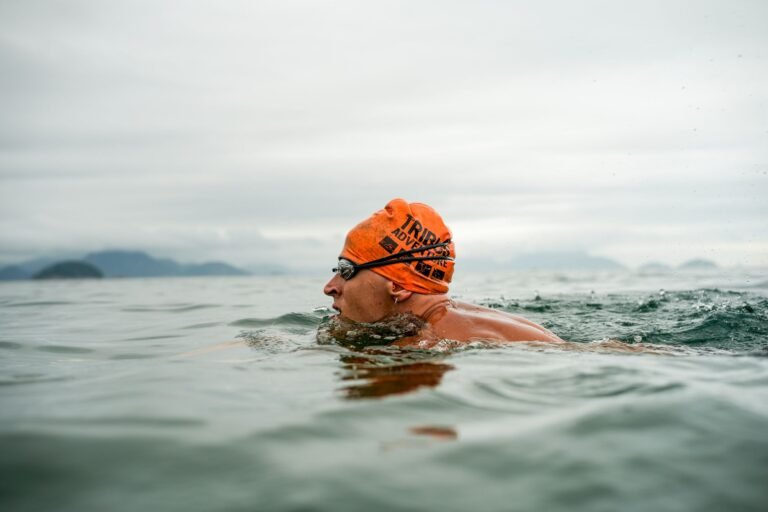
If your goggles seal fine in the driveway test but start leaking as soon as sunscreen, sweat, and saltwater enter the picture, the problem is usually not solved by cranking the strap tighter.
This guide is about the awkward kind of open-water leak: the one that shows up after you have applied sunscreen, walked to the start, warmed up in the ocean, or taken the first few strokes through chop.
The leak that does not show up at home
A dry fit test can make a pair of goggles look perfect. Press them gently to your face, they hold for a second, and the seal feels even. Then the real swim starts. Sunscreen sits on the cheekbone. Saltwater dries at the gasket edge. Your cap moves. You turn to breathe into chop. Suddenly one eye is filling slowly, and the only thing you can think about is the strap.
That is the trap. Strap tension is only one part of the seal. In open water, the seal is a small meeting point between skin, silicone, movement, and water. Sunscreen changes that meeting point. Salt makes it less clean. Waves test whether the frame stays planted when your head angle changes.
If you want the deeper fit explanation, the existing guide on why open-water goggles leak is a useful companion. This article stays narrower: what changes when sunscreen and saltwater are the trigger.
A goggle that needs brute-force strap tension to survive sunscreen is usually the wrong shape for your face or the wrong style for that swim.
Do not skip sunscreen. Move it out of the seal line.
The answer is not to go without sun protection. Open-water swimmers spend a lot of time exposed to reflected light, especially in long lake and ocean sessions. Follow the instructions on your sunscreen, apply it early enough that you are not smearing wet product under the gasket, and keep the exact ring where the goggles sit as clean as you reasonably can.
For many swimmers, the practical fix is simple: sunscreen the face, but avoid rubbing a thick layer directly under the goggle skirt. Once your goggles are on, do not keep lifting and reseating them with sunscreen-covered fingers. Every reset can move residue onto the gasket.
A useful pre-swim habit: after sunscreen has set, gently wipe the goggle contact line with a clean towel or damp finger, then put the goggles on once. If you keep adjusting them at the shoreline, the seal gets worse, not better.
Saltwater makes small fit problems louder
Saltwater does not need to destroy a seal to make a leak annoying. It only needs to find a small gap. A pair that leaks a few drops in a pool may feel much worse in the ocean because salt stings, distracts you, and makes every tiny leak feel like a bigger failure.
That is why saltwater goggles should not be chosen only by lens tint. A dark or polarized lens can help with glare, but the gasket still has to work after the first few minutes of movement. If your main issue is ocean comfort and sting, the guide to best goggles for saltwater swimming is worth reading after this one.
Choose the frame based on where the leak starts
The best replacement depends on the leak pattern. A slow leak near the inner corner of the eye usually points toward nose bridge or frame shape. A leak at the outer corner can mean the frame is too narrow or the gasket does not reach your cheekbone evenly. A leak that appears only when you lift your head to sight is often about stability, not softness.
For swimmers whose current goggles feel like they dig into the eye socket and still leak after sunscreen, a wider swim-mask style frame can be the better move. The Aqua Sphere Vista Pro and Aqua Sphere DEFY Ultra style of open-water mask gives more gasket area and a less socket-focused feel. That does not make them the right answer for every race start, but for long training swims where comfort and awareness matter, they solve a different problem than tiny race goggles.
Product direction: look at the Aqua Sphere Vista Pro or Aqua Sphere DEFY Ultra if your leak comes with pressure around the eye socket and you care more about long-swim comfort than a compact racing profile.
Skip this direction if: you want the smallest possible goggle for crowded triathlon starts or you dislike mask-style frames.
If your face is smaller and a full mask feels like too much frame, the Aqua Sphere Kayenne Compact Fit is a more compact wide-view option from the Finder. It makes sense when standard-size open-water goggles feel oversized but pure racing goggles feel too narrow or unforgiving.
If your leak only appears in chop, on turns around buoys, or when other swimmers disturb the water, softness is not the only priority. A more race-oriented option like the ROKA R1 may be more sensible because the buying problem is stability. The tradeoff is comfort: a secure race feel is not always the same as a relaxed long-swim feel.
When a pool goggle is enough – and when it is not
A familiar pool goggle can work outdoors if the fit is already reliable. The Speedo Vanquisher 3.0 Mirrored is the kind of compact mirrored option some swimmers like because it feels familiar and is easy to keep as a backup. The mistake is assuming a pool goggle will fix a sunscreen leak just because it is smaller or tighter.
If a compact goggle already sits cleanly on your face, a mirrored lens can be useful for bright water. If it only seals when you tighten the strap hard, sunscreen and saltwater will probably expose that weakness. In that case, change the shape before you blame the ocean.
The 5-minute shoreline routine
This is not a complicated routine, but it works because it avoids the two behaviors that make leaks worse: rushing and constant reseating.
- Apply sunscreen early enough that you are not putting goggles over a wet layer.
- Keep the exact gasket path as clean as possible.
- Seat the goggles gently once, then adjust the strap only enough to keep them stable.
- Turn your head left and right before entering the water. If the seal breaks on land, it will not improve in chop.
- After an ocean swim, rinse the goggles with fresh water and let them dry away from sand and direct heat.
This routine pairs well with the broader race-morning goggle routine. The point is not to create another checklist for the sake of it. The point is to reduce how many times you touch the seal once sunscreen and saltwater are involved.
How to decide what to buy next
If your current goggles only leak after sunscreen, try changing your application routine before buying anything. If the same leak happens even when the seal line is clean, the frame probably does not match your face well enough for open water.
If your eyes hurt after a while, read the guide on goggles that hurt after 30 minutes before buying another low-profile pair. If you are deciding between compact goggles and a wider mask, the swim mask vs goggles guide explains the tradeoff more clearly. And if you are still not sure which direction fits your swim, the Open Water Goggles Finder is the easiest place to start because it begins with the actual problem: leaking, glare, fogging, comfort, race day, or low light.
My practical recommendation: do not buy a darker lens to solve a seal problem. Lens choice helps with glare. Frame shape, gasket contact, and pre-swim setup fix sunscreen and saltwater leaks.
Final take
Sunscreen and saltwater do not create a completely new goggle problem. They reveal the weak point in the fit. A pair that seals easily, sits evenly, and stays stable when you sight will handle sunscreen and ocean water better than a pair that only works when the strap is tight.
Start with the seal line. Then look at frame shape. Only after that should you worry about whether the lens is clear, mirrored, or polarized. The buying problem is not just visibility. It is whether the goggles can stay comfortable and sealed after real open-water conditions show up.