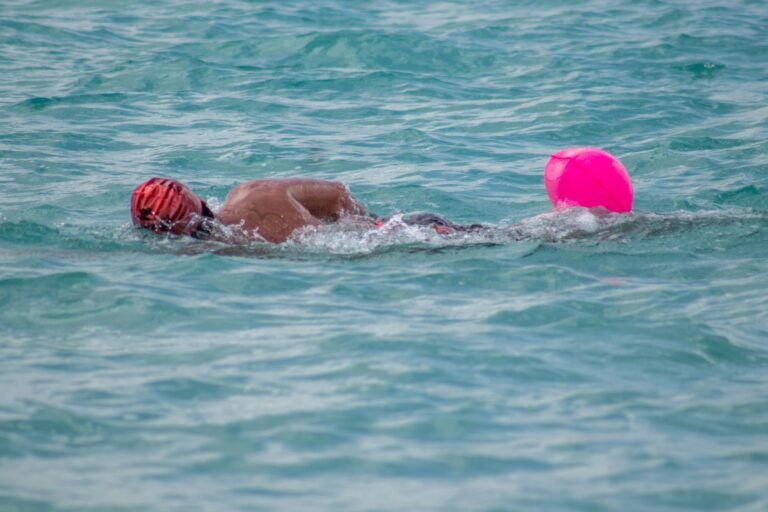
Swimming off course is usually not a fitness problem
You can feel smooth, strong and controlled, then look up and realize the buoy is no longer in front of you. In open water, a straight line is not automatic. It is a skill built from sighting rhythm, breathing balance, landmark choice, calm corrections and gear that lets you see without fighting the water.
The quick answer
You swim off course in open water because the pool removes the problems that open water gives back: no black line, moving water, glare, chop, crowded starts, uneven breathing and weak landmarks. The fix is not to lift your head higher. The fix is to sight earlier, sight smaller, use better landmarks, balance your stroke, and correct direction before a small drift becomes a long detour.
The frustrating part is that swimming off course often feels invisible while it is happening. You do not feel yourself turning. You just arrive somewhere slightly wrong. Then you spend the next hundred meters correcting, losing time, rhythm and confidence.
This guide is about diagnosing that drift and fixing it in a practical way. For the actual sighting mechanics, pair it with how to sight in open water without losing rhythm.
The five reasons swimmers drift off line
Most swimmers blame sighting first. That is sometimes true, but sighting is only one layer. Direction in open water comes from the way your eyes, body and environment interact. When one layer is weak, you start swimming a curved line while your effort still feels honest.
1. You wait too long to sight
If you wait until you are unsure, you are already correcting late. A tiny angle error becomes a wide arc over several minutes. Sighting should confirm direction before you feel lost.
2. Your breathing pulls you sideways
Many swimmers drift toward the side they breathe to most often. The head turns, the lead arm crosses slightly, the body rolls unevenly, and the line slowly bends.
3. You pick a weak target
A buoy can disappear behind chop, swimmers or glare. If your only landmark is small and low on the water, every sighting look becomes a little guess.
4. The water is moving you
Wind, current and chop can push you without changing how your stroke feels. You may be swimming straight relative to your body but not straight relative to the course.
5. Your goggles make seeing hard
Fog, glare, dark lenses, water drops or narrow vision can turn each sighting look into a blurred snapshot. If you cannot recognize the target quickly, you lift higher and disrupt the stroke more.
6. You follow the wrong feet
Drafting is useful until the swimmer in front is also off course. In races, a confident-looking pack can still be taking the scenic route.
Diagnose your drift pattern
Do not treat every off-course swim the same way. The fix depends on the pattern. After a training swim or race, ask what kind of wrong line you swam.
This diagnosis also helps you choose better goggles. A swimmer who loses the buoy in glare has a different problem from a swimmer whose goggles leak every time they lift the head. For gear-specific help, start with the open water goggle lens color guide and the wide-view ocean goggles guide.
The straight-line system: eyes, body, environment
Instead of thinking, “I need to sight more,” think in three layers. Each layer should reduce the amount of correction the next layer has to do.
Eyes: find the course quickly
Your sighting look should be brief and useful. You do not need to admire the buoy. You need enough information to know whether the line is still correct.
Body: stop creating drift
A balanced body line means fewer corrections. If every breath pulls you sideways, sighting becomes damage control rather than navigation.
Environment: read what moves you
Wind, chop, current, sun angle and other swimmers all change the line. A smart swimmer adjusts early instead of pretending the water is a pool lane.
Fix 1: Sight before you feel lost
The biggest shift is mental. Sighting is not a rescue move. It is a rhythm. When you use it only after doubt appears, you are asking one big look to fix a problem that has already grown.
Start with a simple range. In calm water, many swimmers do well sighting every 6 to 10 strokes. In chop, low visibility, heavy traffic or the first minute after a turn buoy, sight more often. If you naturally swim very straight, you may stretch the interval. If you know you drift, shorten it until your line improves.
A good sighting look has one job: confirm or correct. If you lift and cannot identify anything, the problem may be your target, lens, fog, glare or timing, not your courage.
Fix 2: Use landmarks bigger than the buoy
Buoys are obvious on the race map and surprisingly easy to lose from water level. Waves hide them. Sun glare washes them out. A pack of swimmers can block them at the exact moment you lift your eyes.
Before you start, stand on shore and build a landmark stack:
- Primary target: the buoy, turn marker or swim exit you are aiming for.
- Backup target: a tree line, building, hill, pier, lifeguard tower, inflatable arch or shoreline shape behind the buoy.
- Peripheral cue: the sun direction, shoreline angle, other swimmers or course ropes if present.
- Warning cue: a place you should not be drifting toward, such as a boat line, dock or wrong side of the pack.
The backup target is often what saves the swim. You may miss the small buoy for one breath, but still recognize the large dark tree line behind it. That keeps you from making a nervous, unnecessary correction.
Fix 3: Stop letting one-sided breathing steer the swim
You do not need perfect bilateral breathing to swim open water well. But you do need to know whether your preferred breathing side is steering the boat.
Try this in a safe pool lane when nobody is in front of you: swim several lengths at normal effort and notice whether your hand entry crosses the centerline after you breathe. Also notice whether one arm pulls wider or shorter after the breath. Small asymmetries are normal. A repeated pull to one side becomes navigation debt in open water.
Useful fixes include breathing occasionally to the other side, keeping the lead arm patient during the breath, entering the hand in front of the shoulder rather than across the head, and using sighting as a light check instead of a violent reset.
Fix 4: Correct with small angles, not panic turns
A common open-water mistake is waiting too long, realizing you are wide, then turning sharply back toward the buoy. That creates a zigzag: wrong line, hard correction, wrong line again.
When you notice you are slightly off, change the line gently. Aim just inside the target for a few strokes, then recheck. The goal is to bend the course back without stopping your body from moving forward.
| What you notice | Better correction | Avoid this |
|---|---|---|
| Buoy is slightly right | Angle right gradually for 4-8 strokes, then sight again. | Stopping, breaststroking and making a full panic turn. |
| You are outside the pack | Check whether the pack is correct before rejoining it. | Assuming the crowd always knows the best line. |
| A wave blocks your sighting look | Take another small look on the next swell or breath cycle. | Lifting higher and higher until your legs sink. |
| The sun hides the buoy | Use the backup landmark behind or beside the buoy. | Staring into glare until your stroke falls apart. |
Fix 5: Match goggles to the visibility problem
This is where goggles matter, but not in a magical way. Better goggles will not make a crooked stroke straight. They can, however, make each sighting look faster and calmer. That matters because open-water navigation depends on quick recognition.
If glare is the issue
Use a lens that cuts brightness without making the water too dark. Polarized, mirrored or smoke lenses can help in bright sun, but low morning light may need a lighter option. See the photochromic vs polarized guide for the tradeoff.
If the target feels narrow
A wider field of view can make it easier to catch buoy movement, shoreline shape and nearby swimmers without lifting as high. This is especially useful in ocean chop and busy races.
If fog is the issue
A fogged lens makes sighting feel like guessing. Use a practiced anti-fog routine and avoid rubbing the inside lens at the start. Our fogging guide covers the routine.
If the seal breaks when sighting
The problem may be fit or strap tension, not sighting skill. Read why open water goggles leak and how tight goggles should be.
Drills that teach you to swim straighter
Do these in safe conditions, ideally with a partner, coach, lifeguarded area or calm open-water venue. Navigation practice should build confidence, not create risk.
- The six-look set: Pick a visible target and swim six sighting looks without changing effort. Your goal is not speed; it is seeing the target without lifting your whole chest.
- The landmark ladder: From shore, choose a buoy, then a larger object behind it, then a shoreline cue. During the swim, practice switching between the three without panic.
- The drift test: Swim 50-100 relaxed strokes in calm water while sighting less often than usual. See which way you naturally drift. This tells you what your body does without constant correction.
- The correction set: Intentionally aim slightly left or right of a target, then practice returning to the line with small angle changes instead of stopping.
- The missed-look drill: In light chop, accept that some sighting looks will fail. Practice taking a second calm look on the next cycle instead of lifting higher immediately.
Race-day strategy: do not let the first minute decide the whole line
The first minute of an open-water race is noisy. Bodies are close, bubbles are everywhere, and the easiest thing to do is follow the churn in front of you. That may be fine if the group is swimming the right line. It is expensive if they are not.
Before the start, decide your first three navigation cues: the first buoy, the backup landmark, and the sighting frequency for the first minute. You can relax later if the line is obvious. Starting with no plan is how swimmers get pulled sideways before they even settle into rhythm.
Mass start
Sight early, protect your goggles, and do not assume the middle of the pack is the shortest route. The first clear line is often worth more than the most crowded line.
Rolling start
You have more space, so use it. Settle into rhythm quickly but keep checking direction until you pass the first major landmark.
Ocean start
Expect sighting looks to be blocked by chop. Use taller landmarks and take calm repeat looks instead of forcing one perfect look through a wave.
If you are preparing for a longer triathlon swim, connect this with the Ironman goggles guide and the race-morning goggle routine.
Common mistakes that keep swimmers off course
- Only practicing sighting on race week. Sighting changes body position. Treat it like part of the stroke, not an accessory.
- Staring at the buoy too long. Long looks drop the legs and interrupt rhythm. Quick recognition is better than perfect sightseeing.
- Using the wrong lens for the light. A lens that is too dark or too reflective for the conditions can make every sighting look slower.
- Following feet without checking. Drafting saves energy, but the swimmer ahead may be drifting too.
- Correcting too late. The longer you wait, the bigger the correction feels. Small early checks are calmer.
- Blaming goggles for a body-line problem. Gear helps visibility; it does not replace balanced stroke mechanics.
A simple plan for your next three swims
Do not try to fix everything in one session. Give each swim one job.
Swim 1: Diagnose
Notice whether you drift left, right, randomly, only in chop, or only when breathing to one side. Do not chase speed yet.
Swim 2: Build rhythm
Practice a consistent sighting interval and keep the look small. Your goal is to stay calm while checking more often.
Swim 3: Add conditions
Practice with glare, chop, a different target or a small group. Straight swimming has to survive real water, not just perfect water.