Race-Day Gear Reviews
An Ironman swim is long, crowded, and mentally demanding. Your goggles need to stay clear, seal comfortably, handle changing light, and help you sight buoys without constant adjustment.
In this guide, we compare five triathlon swim goggles for Ironman races, 70.3 events, long open-water training, and race day. We focus on fit security, anti-fog design, field of view, lens type, comfort, sighting, and race-day reliability.
Best Triathlon Swim Goggles for Ironman: Quick Picks
Best Overall for Ironman
Zoggs Predator Flex Polarized
Best for triathletes who want a secure open-water fit, glare reduction, and comfort for long race-day swims.
Best Wide View
Aqua Sphere Kayenne Polarized
Best for swimmers who want wider visibility for buoy sighting, crowded starts, and open-water awareness.
Best Race Fit
Arena Cobra Ultra Swipe
Best for experienced triathletes who prefer a compact race-style goggle with Arena’s Swipe anti-fog system.

Comparison Table: Best Triathlon Swim Goggles for Ironman & Open Water
Use this table to compare each pair by best use, key feature, lens type, and race-day purpose.
| Product Name | Best For | Key Feature | Lens Type | Check Price |
|---|---|---|---|---|
| Zoggs Predator Flex Polarized | Best overall Ironman pick | Flexible frame and secure open-water fit | Polarized | View on Amazon |
| Aqua Sphere Kayenne Polarized | Wide-view sighting | Large curved lens for open-water awareness | Polarized | View on Amazon |
| Arena Cobra Ultra Swipe | Race fit and anti-fog | Swipe anti-fog technology | Mirrored | View on Amazon |
| FORM Smart Swim 2 | Training data and pacing | In-goggle display and swim metrics | Clear / Tinted | View on Amazon |
| ZONE3 Venator-X Polarised | Premium open-water racing | Triathlon-focused outdoor design | Polarised | View on Amazon |
How We Chose These Ironman Swim Goggles
Ironman goggles need to do more than feel good for a short pool session. They must stay sealed through a long open-water swim, repeated sighting, contact with other swimmers, and changing light conditions.
Our recommendations use triathlon-specific buying criteria and the product information available for each model. Where first-hand observations are available, we distinguish them from manufacturer specifications and other published information rather than presenting every source as hands-on testing.
We compared each pair based on:
- Seal stability during long open-water swims
- Comfort over 1.2-mile and 2.4-mile swim distances
- Anti-fog performance and lens care requirements
- Field of view for buoy sighting and crowded starts
- Lens usefulness for bright sun, glare, clouds, and early starts
- Fit security during waves, drafting, and head movement
- Suitability for Ironman training, race day, and backup use
- Overall value for triathletes
To understand our editorial process, read our How We Test Swim Goggles page.
What Matters Most in an Ironman Swim Goggle?
In an Ironman race, goggles are not just comfort gear. They affect your ability to sight, stay calm, hold rhythm, avoid unnecessary stopping, and exit the water without wasting energy.
The best race-day goggles should feel familiar before the event. Do not use brand-new goggles for the first time on race morning. Test them in open water, practice sighting, and confirm that the lens tint works for your usual race conditions.
| Race-Day Need | Why It Matters | What to Look For |
|---|---|---|
| No leaking | Stopping during the swim costs time and raises stress. | Stable gasket, correct nose bridge, tested fit |
| Clear vision | Fogging makes sighting harder and can increase anxiety. | Reliable anti-fog coating and good care routine |
| Good sighting | Swimming off course adds distance and wastes energy. | Wide enough field of view and suitable lens tint |
| Comfort | Small pressure points become worse over long swims. | Soft gasket, balanced strap tension, secure seal |
| Right lens tint | Wrong tint can be too dark or too bright for race conditions. | Polarized, mirrored, smoke, clear, or photochromic based on light |
Triathlon Swim Goggles vs Pool Racing Goggles
Pool racing goggles can work in a triathlon, but the priorities are different. A pool race is short and predictable; an open-water triathlon adds glare, waves, contact, repeated sighting, and much longer wear time.
Triathlon and Ironman Goggles
- Prioritize a stable seal through head movement and contact.
- Need enough field of view for buoy sighting and pack awareness.
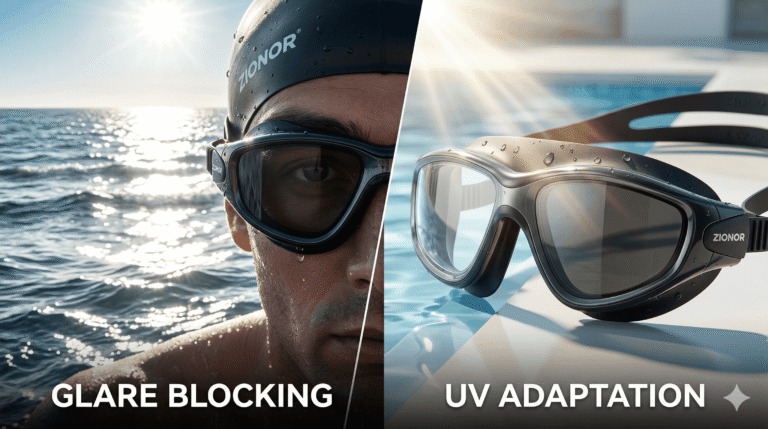
- Benefit from outdoor lens options for glare and changing light.
- Should remain comfortable over long open-water swims.
- Need anti-fog performance that holds up beyond a short pool race.
Pool Racing Goggles
- Often prioritize a compact, low-profile shape.
- Can use a narrower field of view because lane navigation is predictable.
- May feel firmer around the eye socket.
- Do not always need glare control or changing-light flexibility.
- Can still be a good triathlon choice if you have tested them successfully in open water.

The 5 Best Swim Goggles for Ironman Races
Best Overall for Ironman
1. Zoggs Predator Flex Polarized
Zoggs Predator Flex Polarized is our best overall pick for Ironman races because it offers a strong balance of fit security, comfort, open-water visibility, and glare reduction.
The flexible frame helps the goggles sit more naturally on the face, which can reduce pressure during long swims. The polarized lens is especially helpful for bright lake, ocean, or river races where surface glare can make sighting more difficult.
Pros
- Strong all-around choice for Ironman and 70.3 races
- Polarized lens helps reduce water glare
- Flexible frame improves comfort on longer swims
- Secure enough for triathlon training and race day
- Good balance of visibility and fit stability
Cons
- Not the cheapest option
- Polarized lens may be too dark for low-light race starts
- Fit still depends on face shape
- Not as compact as narrow pool-racing goggles
Who Should Buy It
- Ironman and 70.3 triathletes
- Swimmers racing in bright open-water conditions
- People who want a secure but comfortable fit
- Triathletes who need one dependable race-day pair
Who Should Avoid It
- Indoor-only swimmers
- Budget-only buyers
- Low-light swimmers who prefer clear lenses
- People who only want ultra-compact racing goggles
Verdict: Best overall Ironman pick for triathletes who want comfort, fit security, and polarized visibility in one race-ready package.
Best Wide View for Sighting
2. Aqua Sphere Kayenne Polarized
Aqua Sphere Kayenne Polarized is the best pick for triathletes who want more open-water awareness. Its larger curved lens design gives a wider view than many compact racing goggles.
This makes it especially useful for crowded starts, buoy sighting, lake swims, and ocean races where peripheral vision can help you stay oriented and calm.
Pros
- Excellent field of view for open-water sighting
- Polarized lens helps reduce glare
- Comfortable fit for longer swims
- Good option for beginners and experienced triathletes
- Less restrictive than many narrow race goggles
Cons
- Not as compact as race-focused goggles
- May feel large for very small faces
- Polarized lens may be too dark for dawn race starts
- Usually costs more than basic goggles
Who Should Buy It
- Triathletes who prioritize sighting visibility
- Beginner Ironman swimmers
- Open-water swimmers who dislike narrow goggles
- Racers who want comfort and awareness
Who Should Avoid It
- Swimmers who want a minimal race profile
- People with very small faces
- Indoor-only swimmers
- Race starts in very low light
Verdict: Best for Ironman swimmers who want wide visibility, easier sighting, and a more open visual feel.
Best Race Fit and Anti-Fog
3. Arena Cobra Ultra Swipe
Arena Cobra Ultra Swipe is best for experienced triathletes and strong swimmers who prefer a compact, race-style goggle. It has a lower-profile fit than wide-view open-water goggles and is built for performance.
Its Swipe anti-fog system is the main reason to consider it for long-distance racing. For swimmers who prioritize a compact race feel and a reactivatable anti-fog system, it is a relevant option to compare.
Pros
- Reactivatable Swipe anti-fog system
- Compact race-style fit
- Good option for experienced triathletes
- Mirrored lens works well in bright conditions
- Secure feel for hard training and race day
Cons
- Race fit may feel firm for beginners
- Not as wide-view as open-water-specific models
- Mirrored lens may be too dark for low light
- More expensive than basic training goggles
Who Should Buy It
- Experienced triathletes
- Swimmers who like compact race goggles
- Racers prioritizing anti-fog performance
- People who already know they like firm race fits
Who Should Avoid It
- Beginner open-water swimmers
- Swimmers who need maximum peripheral view
- People who prefer soft mask-style goggles
- Low-light swimmers who want clear lenses
Verdict: Best for experienced triathletes who want a compact race goggle with a reactivatable Swipe anti-fog system.
Best Smart Goggles for Ironman Training
4. FORM Smart Swim 2
FORM Smart Swim 2 is best for Ironman athletes who want data-driven training. It is not the simplest race-day goggle, but it can be extremely useful during preparation because it displays metrics in the lens while you swim.
This can help triathletes work on pacing, structured workouts, and consistency without stopping to check a watch.
Pros
- In-goggle display for swim metrics
- Useful for pacing and structured Ironman training
- Can reduce the need to stop and check a watch
- Strong option for data-focused triathletes
- Helpful for long training blocks
Cons
- Much more expensive than regular goggles
- Requires charging and app setup
- More technology than some swimmers need
- Not the simplest backup pair for race morning
Who Should Buy It
- Data-focused Ironman athletes
- Triathletes working on pacing
- Swimmers following structured workouts
- People who want metrics inside the lens
Who Should Avoid It
- Budget buyers
- Casual swimmers
- People who dislike charging devices
- Racers who want the simplest possible setup
Verdict: Best for Ironman training and pacing work, especially for athletes who want real-time swim data.
Best Premium Open-Water Pick
5. ZONE3 Venator-X Polarised
ZONE3 Venator-X Polarised is a premium open-water and triathlon goggle for athletes who want a dedicated outdoor racing option.
It is best suited for swimmers who train outdoors regularly and want a more specialized goggle than a basic pool-focused pair.
Pros
- Designed for open-water and triathlon use
- Polarised lens helps in bright conditions
- Premium option for serious athletes
- Good choice for regular outdoor training
- Strong alternative to basic pool goggles
Cons
- Higher price than entry-level goggles
- May be more than beginner triathletes need
- Not ideal for indoor-only swimming
- Availability may vary by retailer
Who Should Buy It
- Regular open-water triathletes
- Ironman athletes who want a premium race pair
- Swimmers training often in bright outdoor water
- People who want an open-water-specific design
Who Should Avoid It
- Budget buyers
- Beginner swimmers who only need a simple pair
- Indoor-only swimmers
- People who prefer cheap backup goggles
Verdict: Best premium pick for Ironman athletes who want a dedicated open-water and triathlon goggle.
Ironman vs 70.3, Olympic and Sprint Triathlon Goggles
The same pair can work across race distances, but the longer the swim, the more important comfort and pressure become. For an Ironman or long-course event, a small hotspot around the eye socket can become distracting over time. In a shorter sprint or Olympic-distance race, some experienced swimmers are more willing to trade comfort for a compact race fit.
Race distance does not change the need for a secure seal, suitable lens tint, and reliable sighting. It mainly changes how heavily you should weight long-swim comfort when choosing between otherwise suitable triathlon goggles.
Race-Day Lens Guide for Ironman Swims
The best lens depends on the race location and start time. Many Ironman swims start early, so a lens that works perfectly at noon may be too dark at the beginning of the swim.
| Race Condition | Best Lens Type | Why |
|---|---|---|
| Bright sunny lake or ocean | Polarized or mirrored | Reduces glare and brightness from the water surface |
| Early morning start | Clear, light smoke, or photochromic | Maintains visibility before full sun |
| Cloudy race day | Clear or light tint | Improves visibility in low contrast |
| Changing light | Photochromic or moderate tint | Handles changing sun and cloud cover |
| Strong glare | Polarized | Targets horizontal glare from the water surface |
For a deeper lens comparison, read our guide to photochromic vs polarized swim goggles. If glare is your main problem, compare our polarized goggles for open water.
Ironman Goggle Checklist Before Race Day
Before the race, confirm that your goggles:
- Have been tested in open water, not just the pool
- Seal without painful strap tension
- Stay clear for at least your expected swim duration
- Have a lens tint that matches expected race conditions
- Do not leak when you sight forward
- Feel comfortable under your swim cap
- Are easy to adjust before entering the water
- Have a backup pair ready in your race bag
Should You Use One Pair or Two for Ironman Training and Race Day?
One-Pair Strategy
Use one dependable pair for both training and racing if it has been tested in the same type of water, light, and swim duration you expect on race day. This keeps your setup simple and familiar.
Two-Pair Strategy
Keep one pair for regular training and a second tested pair for race day. A backup with a different lens tint can also help if race morning is much brighter or darker than expected.
Common Mistakes When Choosing Ironman Goggles
Using New Goggles on Race Day
New goggles may leak, pinch, fog, or feel different under a swim cap. Always test your race pair during training.
Choosing Lenses That Are Too Dark
Early starts can be darker than expected. Very dark lenses may make buoys harder to see before the sun is fully up.
Ignoring Sighting Visibility
A fast-looking pool goggle may feel too narrow in open water. Choose a lens shape that lets you sight confidently.
Over-Tightening the Strap
A painful strap does not fix a poor seal. If the goggles only work when extremely tight, choose a better-fitting pair.
Frequently Asked Questions
What are the best triathlon swim goggles for Ironman races?
Zoggs Predator Flex Polarized is our best overall Ironman pick because it balances fit security, comfort, and glare reduction. Aqua Sphere Kayenne Polarized is best for wide-view sighting, while Arena Cobra Ultra Swipe is best for compact race fit and anti-fog performance.
Should I use polarized goggles for an Ironman swim?
Polarized goggles are useful for bright Ironman swims because they help reduce glare from the water surface. For early morning or cloudy starts, clear, light-tint, or photochromic lenses may be easier to see through.
Should I race with wide-view or low-profile goggles?
Wide-view goggles are better for sighting and open-water awareness. Low-profile goggles can feel faster and more secure for experienced swimmers. The right choice depends on comfort, fit, and how confident you are in open water.
How do I prevent goggles from fogging during an Ironman swim?
Use goggles with a reliable anti-fog coating, avoid rubbing the inside of the lenses, rinse gently after training, and test your race pair in similar water and weather conditions before the event.
Should I bring backup goggles to an Ironman race?
Yes. Bringing a backup pair is smart. Ideally, your backup should be a tested pair with a different lens tint in case race-day light conditions change.
Are smart goggles allowed for Ironman races?
Race rules can vary by event and governing body, so check the current athlete guide for your specific event before race day. Smart goggles are most useful for training, pacing practice, and structured workouts.
Are triathlon swim goggles different from pool racing goggles?
They can be. Triathlon goggles often place more emphasis on sighting, outdoor lens options, long-swim comfort, and seal stability during head movement and contact. Pool racing goggles often prioritize a compact low-profile shape.
Do I need separate goggles for Ironman training and race day?
Not necessarily. One tested pair can work for both. Some triathletes prefer a second tested race-day or backup pair, especially when they want a different lens tint for changing light.
Final Verdict
The best swim goggles for Ironman races depend on your fit preference, race conditions, and open-water experience. For most triathletes, the Zoggs Predator Flex Polarized offers the best overall balance of comfort, security, and glare reduction.
If you want maximum open-water awareness, choose the Aqua Sphere Kayenne Polarized. If you prefer a compact race fit and a reactivatable anti-fog system, the Arena Cobra Ultra Swipe is the option to compare. For training data, FORM Smart Swim 2 is the most advanced option. For a premium open-water race goggle, consider the ZONE3 Venator-X Polarised.
Our Top Ironman Pick
For most Ironman and 70.3 athletes, the Zoggs Predator Flex Polarized is the best starting point because it combines race-day security, polarized visibility, and long-swim comfort.