Swimming in a controlled indoor pool is a luxurious experience. The water temperature is perfectly regulated, there are zero waves, and most importantly, there is a thick black line painted on the bottom of the pool to guide your exact path. You can completely zone out, drop your head, and focus entirely on the mechanics of your freestyle pull without ever worrying about where you are going.
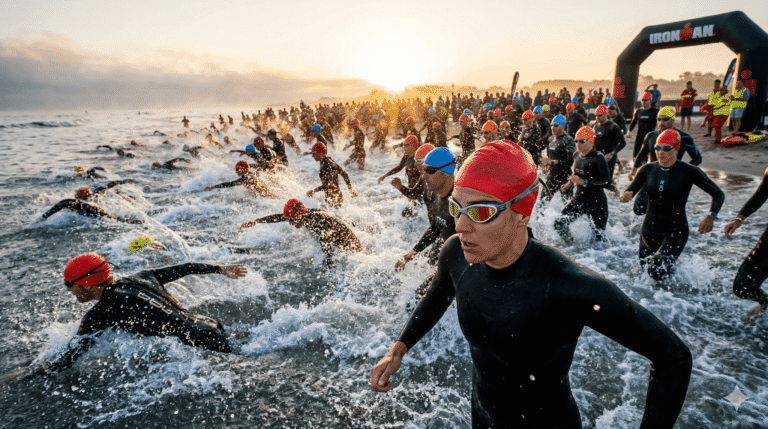
Ocean swimming, however, is a radically different beast. When you transition to the vast, unpredictable open water, that comforting black line disappears entirely. You are suddenly faced with dark, opaque water, powerful cross-currents, and blinding sun glare. In this environment, your ability to navigate—a skill known as “sighting”—becomes the single most critical element of your race. If you cannot sight effectively, you will swim in a zigzag pattern, adding massive, exhausting distance to your 5K or Ironman swim.
However, perfect sighting technique is completely useless if your equipment restricts your vision. Finding the best wide view swim goggles for ocean swimming is a matter of survival. You need expansive peripheral vision to locate tiny racing buoys on the horizon without having to violently twist your neck or stop swimming.
In this comprehensive 2026 guide, the gear analysts at OpenWaterGoggles.com will break down the absolute best wide-view goggles on the market, explain the biomechanical secrets of efficient sighting, and show you how to master the open water without wasting precious energy.

Quick Comparison: Top Wide View Goggles of 2026
To help you secure the maximum field of vision for your next ocean race, here is a quick breakdown of our highest-rated, field-tested goggles.
| Product Name | Best For | Key Feature | Lens Type | Check Price |
|---|---|---|---|---|
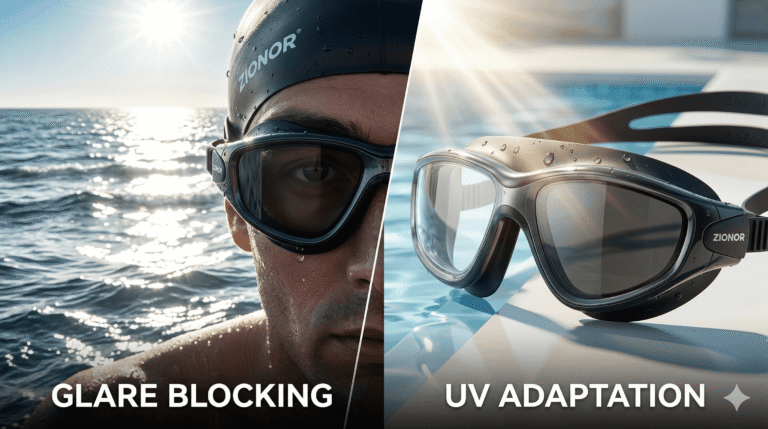
| ZIONOR Upgraded G1 | Sunny Ocean Swims | Extra-wide peripheral vision | Polarized | Check Today's Deal |
| Magic5 Custom | Hard-to-fit/Small Faces | 3D-scanned custom fit | Various | Check Today's Deal |
| FORM Smart Swim 2 | Tech-Savvy Triathletes | AR display & Heart Rate | Clear/Tinted | Check Today's Deal |
| Arena Cobra Ultra | Long Endurance Swims | Swipe Anti-Fog Technology | Mirrored | Check Today's Deal |
| Aegend Swim Goggles | Budget & Back-up Gear | Easy-plug buckle system | Clear/Tinted | Check Today's Deal |
The Sighting Stress Test: How We Evaluate Ocean Gear
At BestSwimGoggles.com, our testing methodology goes far beyond reading the manufacturer’s packaging. Our lead gear expert, Marcus Vane, and a team of seasoned marathon swimmers subject every pair of goggles to a brutal, multi-stage evaluation process in actual open-water environments.
When determining the best wide view swim goggles for ocean swimming, we specifically focus on three critical factors:
1. The 180-Degree Peripheral Test: Pool goggles are designed to look straight down. Ocean goggles must look forward and sideways. We test the curvature of the lens in choppy ocean water to ensure the swimmer can spot a buoy or a safety kayak out of the corner of their eye without fully turning their head.
2. The 60-Minute Leak & Sighting Check: Sighting requires you to repeatedly lift your head out of the water. This mechanical neck movement stretches the facial skin and often breaks the silicone seal of cheap goggles. We wear each pair for over 60 minutes of continuous ocean swimming to ensure the suction remains perfectly watertight during heavy sighting maneuvers.
3. Sun Glare Neutralization: Having a wide view is useless if you are blinded by the sun. We stress-test polarized and mirrored coatings against direct, horizontal UV sunlight to evaluate how well the lenses cut through ocean glare, allowing for crystal-clear buoy acquisition.
The 5 Best Wide View Swim Goggles for Ocean Swimming
After extensively testing the hydrodynamics, comfort, and optical clarity of dozens of models, these five goggles provide the ultimate panoramic experience for ocean athletes.
1. Best Overall for Peripheral Vision: ZIONOR Upgraded G1 Polarized
If your primary goal is to see as much of the ocean as physically possible, the ZIONOR Upgraded G1 is the absolute gold standard for wide-view optics.
Why it dominates the ocean: These goggles bridge the gap between a traditional swim goggle and a scuba mask. They feature aggressively curved, oversized lenses that stretch further around the temples than standard models. This panoramic design provides a near 180-degree field of vision, making it incredibly easy to keep track of your competitors and spot navigation buoys in the distance.
The Tech & Fit: Ocean swimming often means battling the sunrise. The ZIONOR G1 is equipped with high-grade polarized lenses that actively filter out the blinding horizontal light waves bouncing off the ocean swells. Furthermore, the wider silicone gasket disperses pressure evenly across the cheekbones, preventing the dreaded “goggle headache” during a long marathon swim.
The Verdict: For triathletes and wild swimmers who feel claustrophobic in standard, low-profile racing goggles, this wide-view panoramic design is a massive breath of fresh air and a crucial navigational tool.
2. Best for Custom-Fitted Clarity: Magic5 Custom Goggle
A wide field of view is completely ruined if your lenses are constantly filling up with stinging saltwater. The Magic5 Custom Goggle offers incredible peripheral vision paired with a mathematically perfect, leak-proof seal.
Why it dominates the ocean: Using an advanced smartphone app, the Magic5 system 3D-scans the exact topography of your face. The goggles are then custom-printed to fit the specific depth of your eye sockets and the width of your nose bridge. Because the fit is so precise, the lenses can sit slightly closer to the eye without causing eyelash friction, which naturally widens your field of view—much like standing closer to a window.
The Tech & Fit: Sighting requires violent, repetitive neck movements that easily break the seal of generic goggles. Because the Magic5 is custom-fitted, it requires virtually no strap tension to stay securely attached to your face, completely eliminating leaks regardless of how aggressively you sight the buoys.
The Verdict: If you want premium optical clarity, excellent lateral vision, and a 100% guarantee against saltwater leaks, this 3D-scanned technology is worth every single penny.
3. Best Anti-Fog View: Arena Cobra Ultra Mirror Swipe
Fog is the ultimate enemy of ocean navigation. It does not matter how wide your lenses are if they are completely clouded over with condensation. The Arena Cobra Ultra solves this problem with groundbreaking chemistry.
Why it dominates the ocean: While these are technically low-profile racing goggles, Arena designed the Cobra Ultra with distinctly curved lateral lenses that wrap around the side of the eye socket. This provides a surprisingly massive field of peripheral vision without the bulky drag of a traditional open-water mask.
The Tech & Fit: The true selling point is the revolutionary Swipe anti-fog technology. If your lenses start to fog up halfway through your ocean swim due to temperature changes, you do not need to stop. You simply swipe the inside of the wet lens with your finger. This physical friction reactivates the chemical anti-fog layer, restoring crystal-clear, wide-angle vision instantly.
The Verdict: For competitive triathletes who want the sleek speed of a racing goggle combined with excellent peripheral vision and indestructible anti-fog performance, the Cobra Ultra is unmatched.
4. Best High-Tech Sighting: FORM Smart Swim 2
Sometimes, the best way to navigate the ocean is with real-time digital data. The FORM Smart Swim 2 brings augmented reality into the open water.
Why it dominates the ocean: While the physical lens provides a solid, standard field of view, the integrated Augmented Reality (AR) display is what makes this goggle incredible. When paired with a compatible GPS watch, the AR display projects your live metrics—including your exact distance, split times, and stroke rate—directly into your line of sight.
The Tech & Fit: You no longer need to break your stroke or alter your sighting technique to look at your wrist. You can keep your eyes completely focused on the horizon and the buoys while monitoring your pacing perfectly. The built-in heart rate monitor ensures you do not burn out during the grueling mass start.
The Verdict: If you are a data-obsessed triathlete who wants to perfectly execute a race plan without ever losing sight of the course, this smart wearable is the future of open-water swimming.
5. Best Budget Backup: Aegend Swim Goggles
Every veteran ocean swimmer knows that you must always carry a reliable backup pair of goggles in your transition bag. The Aegend offers incredible wide-view value.
Why it dominates the ocean: Despite the low price tag, the Aegend features surprisingly large, clear lenses set into a highly flexible silicone frame. This design naturally bends to accommodate a wide variety of facial structures, providing a generous field of view that rivals much more expensive brands.
The Tech & Fit: The easy-plug buckle system makes them incredibly fast to put on and adjust, which is a lifesaver if your primary goggles snap just minutes before the starting horn blows. The silicone seals are thick, comfortable, and highly effective at preventing leaks during heavy ocean chop.
The Verdict: You should never tackle the open ocean without an insurance policy. The Aegend is the ultimate, budget-friendly wide-view backup pair that performs brilliantly under pressure.
Master the Open Water: Sighting Techniques and Mechanics
Buying the best wide view swim goggles for ocean swimming is only 50% of the equation. To truly swim in a straight line, you must master the physical mechanics of sighting.
Many amateur swimmers make the catastrophic mistake of stopping their stroke, lifting their entire chest out of the water, and treading water to look for the buoy. This completely destroys your forward momentum, drops your hips, and forces you to burn massive amounts of energy to get back up to speed. Here is how the elite professionals sight seamlessly.
1. The “Alligator Eyes” Technique
The golden rule of sighting is to expose as little of your face to the wind as possible. You should aim to mimic an alligator resting at the surface of a swamp.
As your lead arm extends forward to initiate the catch phase of your freestyle stroke, gently press down on the water. Use this slight downward pressure to lift your head just enough so that only your eyes and the bridge of your goggles break the surface. The water line should literally be resting right beneath your goggle lenses. You only need a fraction of a second to take a mental snapshot of the horizon. Do not lift your mouth or your chin out of the water.
2. Separate Breathing from Sighting
One of the biggest mistakes beginners make is trying to sight and breathe at the exact same time. Lifting your head high enough to clear your mouth for air causes your hips and legs to sink drastically, creating an immense amount of hydrodynamic drag.
Instead, you must separate the two actions. First, perform the “Alligator Eyes” lift to look forward and take your mental snapshot of the buoy. Then, as your head naturally drops back down into the water, seamlessly rotate your neck to the side to take your breath, just like a normal freestyle stroke. It is a one-two rhythm: Look forward, then breathe to the side.
3. Sighting Frequency and Symmetrical Pulling
How often should you sight? In calm lakes, you might only need to sight every 10 to 12 strokes. In a choppy ocean with strong cross-currents, you may need to sight every 4 to 6 strokes to avoid being pushed off course.
Furthermore, you must ensure your freestyle pull mechanics are perfectly symmetrical. Everything you need to know about the sprint freestyle pull—how it works and how it differs from regular freestyle—dictates that an uneven pull will naturally steer you off course. If your right arm pulls harder than your left arm, you will naturally swim in circles. Focus on a high-elbow catch and equal power distribution to drastically reduce the number of times you need to sight.
The Mental Edge: Hypothermia and Pre-Race Preparation
Ocean swimming is not just a physical challenge; it is a severe psychological test. Even with perfect sighting technique and the best wide view goggles, your race can be ruined if you do not properly prepare your body for the harsh realities of the open water.
The Subtle Art of Warming Up
When you transition from the beach into a cold ocean, your body experiences a profound shock. If you are not prepared, this cold shock can trigger hyperventilation, panic, and severely impair your ability to execute your sighting technique. Understanding hypothermia and cold water immersion is a mandatory skill for all open-water athletes.
Before the race begins, you must practice the subtle art of warming up. Walk waist-deep into the ocean and begin vigorously splashing the freezing water onto your face, the back of your neck, and your chest. Submerge your face and practice exhaling long, steady streams of bubbles. This controlled, deliberate exposure forces your nervous system to acclimate to the temperature, preventing the mammalian dive reflex from triggering a panic attack when the starting gun fires.
Conquering Pre-Race Nerves
Struggling with pre-race nerves? Here is what swimmers need to know about using pre-race nerves for faster swimming when it counts. The anxiety you feel on the beach is simply your body priming itself for peak physical exertion. Do not interpret this adrenaline as fear.
By investing in high-quality, wide-view goggles that you absolutely trust, you actively eliminate the variable of equipment failure. When you know your goggles will not leak and that your peripheral vision is completely unobstructed, you free up massive amounts of cognitive energy. You can then channel that energy into visualization techniques. Close your eyes, visualize yourself executing the perfect “Alligator Eyes” technique, calmly locating the buoy amidst the chaos, and swimming a perfectly straight, powerful line to the finish. Mental training is one of the most powerful tools in a swimmers arsenal–and one of the most neglected.

Frequently Asked Questions (FAQ)
Q: Why do I always swim to the left or right in the open water, even when I try to swim straight? A: This is almost always caused by an asymmetrical freestyle stroke or unilateral breathing. If you only breathe to your right side, your left arm tends to drop prematurely, causing your body to naturally veer to the left. To swim in a straight line, you must practice bilateral breathing (breathing every three strokes) and ensure your pull power is equal on both sides. Additionally, strong ocean cross-currents can push you off course without you realizing it, which is why frequent sighting is mandatory.
Q: Are clear lenses or polarized lenses better for sighting buoys in the ocean? A: It depends entirely on the weather conditions. For a mid-day ocean swim or a race where you must swim directly into the rising sun, polarized lenses are absolutely superior. They actively block the blinding horizontal glare bouncing off the water, allowing you to easily spot the brightly colored buoys. However, if you are swimming on a very dark, overcast day, or in a murky lake, clear or lightly tinted photochromic lenses will maximize the available light and provide better contrast.
Q: Should I use a large scuba-style mask for open water swimming to get the best wide view? A: While large scuba masks offer incredible peripheral vision, they are highly discouraged for triathlon and fitness swimming. They are extremely bulky, heavy, and create a massive amount of hydrodynamic drag, which will exhaust your neck muscles over long distances. Furthermore, they cover your nose, preventing you from exhaling naturally through your nostrils. Always choose an oversized swim goggle (like the ZIONOR G1) rather than a full scuba mask.
Q: How do I stop my wide view goggles from fogging up during a long ocean swim? A: Wide view goggles have a larger surface area, which can sometimes make them prone to fogging if there is a drastic difference between your body heat and the cold ocean water. Never touch the inside of the lenses with your fingers, as this destroys the factory anti-fog coating. Apply a high-quality, reef-safe anti-fog spray 15 minutes before your swim, or invest in goggles with advanced, reactivating chemical layers like the Arena Cobra Ultra Swipe.
The Final Verdict
Navigating the open ocean is a thrilling, demanding challenge that requires technical precision and the absolute best equipment available. You cannot conquer the water if you cannot see where you are going.
If you demand the absolute maximum field of vision to sight buoys effortlessly, the oversized, panoramic lenses of the ZIONOR Upgraded G1 Polarized are your ultimate weapon against the ocean. If you are exhausted by standard goggles leaking every time you lift your head to sight, the 3D-scanned, mathematically perfect fit of the Magic5 Custom Goggle will change your life. And for the highly competitive triathlete who wants to combine low-profile speed with indestructible anti-fog performance, the Arena Cobra Ultra Mirror Swipe remains an elite, trusted choice.
Upgrade your optics, master the “Alligator Eyes” technique, conquer your pre-race nerves, and we will see you swimming straight and fast to the finish line.