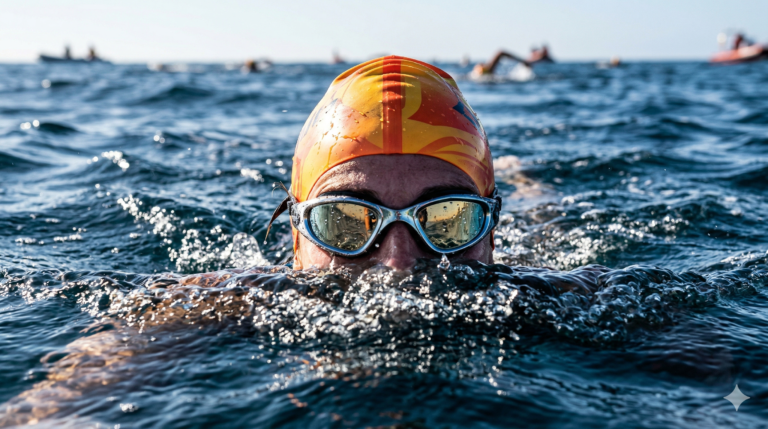
You can spend hundreds of hours rigorously perfecting your high-elbow freestyle pull. You can spend thousands of dollars on the most aerodynamically advanced carbon-fiber wetsuit, and you can religiously follow a brutal, six-day-a-week dryland training program. However, when you stand barefoot on the freezing beach before a mass-start triathlon, surrounded by hundreds of anxious athletes and staring out into the dark, unpredictable expanse of the ocean, none of that physical preparation matters if your mind is not equipped to handle the pressure.
Mental training is the most underutilized discipline in swimming. Many amateur triathletes and wild swimmers treat sports psychology as an optional luxury—something only Olympic-level athletes need to worry about. This is a catastrophic misconception. Mental training is one of the most powerful tools in a swimmers arsenal–and one of the most neglected. It is the biological control center that dictates whether your body will efficiently execute its physical training or completely shut down in a state of hyperventilating panic.
As three-time Olympian and former world record holder Gary Hall Sr. noted, learning how to become a mentally tougher swimmer is a core requirement for success. Furthermore, Olympic gold medalist Cody Miller emphasizes that at the end of the day, it is all about mental toughness; it is all about building what is inside your head so that when you are behind the starting line, you are 100% the most prepared, the most mentally tough, and the most locked in that you can be.
In this comprehensive 2026 masterclass, the performance experts at OpenWaterGoggles.com will dive deeply into the psychology of open-water endurance. We will teach you the core skills that help swimmers train better and race faster when it counts. We will break down exactly how to use visualization, explain why most swimmers set their goals completely backward, and provide you with actionable, elite-level strategies to develop a truly bulletproof mindset for practice and competition.
Part 1: Goal Setting for Swimmers (How to Drive Real Performance)
To achieve greatness in the water, you must have a target. However, most swimmers set goals backwards. When you ask an amateur triathlete what their goal is for an upcoming open-water race, they will almost always give you an outcome-based metric. They will say, “I want to finish the 2.4-mile Ironman swim in under 70 minutes,” or “I want to beat my training partner,” or “I want to finish in the top 10% of my age group.”
Here is how the research says goal setting actually works and how to build a system that drives real performance in the pool and the open water: You must abandon outcome goals and obsess entirely over Process Goals.
The Danger of Outcome Goals
Outcome goals are highly dangerous for your mental stability because they are heavily reliant on variables you cannot control. In order to be great at anything in life, you have to improve the previous version of yourself, which requires identifying what you can and cannot control. You cannot control the ocean’s cross-currents. You cannot control the water temperature, the blinding sun glare, or how aggressively the other swimmers behave during the mass start.
If your only goal is to swim a 70-minute split, and you encounter a massive, unexpected headwind on race morning, your goal is instantly mathematically impossible. When your brain realizes the outcome goal is dead, your motivation collapses, your stroke mechanics fall apart, and destructive panic sets in.
The Power of Process Goals
Process goals are hyper-focused objectives that are 100% within your immediate control, regardless of the environmental chaos happening around you. By focusing on becoming a greater version of yourself through process execution, you systematically overcome the barriers to success.
For your next open-water race, you should write down three specific process goals in your swim logbook. Here is what an elite process-oriented goal structure looks like:
1. The Mechanical Goal: “I will maintain an Early Vertical Forearm (high-elbow catch) for the first 1,500 meters of the race, consciously engaging my lats rather than dropping my elbows when I get tired.” 2. The Navigational Goal: “I will use the ‘Alligator Eyes’ technique to sight the navigation buoys every six strokes, ensuring I swim in a perfectly straight line to avoid adding unnecessary yardage.” 3. The Psychological Goal: “If my goggles get kicked or I swallow a mouthful of saltwater, I will not panic. I will smoothly roll onto my back, tread water for five seconds, take three deep diaphragmatic breaths to lower my heart rate, and immediately resume my stroke.”
When you stand on the beach, you do not think about the finish line. You only think about executing step one, then step two, then step three. This methodical, process-driven focus completely blocks out the anxiety of the “big picture.”
Part 2: Visualization for Swimmers (How to Use It and Why It Works)
Once your process goals are established, you must program them into your central nervous system. Visualization is one of the most powerful mental skills swimmers have for improving performance.
When you vividly imagine performing a physical action, your brain fires the exact same neurological pathways as if you were actually performing the movement in real life. This is not a mystical concept; it is scientifically proven neuroplasticity. However, most age-group athletes use this tool incorrectly. Here is how to use it the right way for faster swimming.
The Flaw of “Perfect Outcome” Visualization
Amateur athletes usually only visualize standing on the podium, receiving a medal, and hearing the crowd cheer. While this releases a brief hit of dopamine, it does absolutely nothing to prepare your body for the grueling physical reality of a cold-water swim. If you only visualize perfection, your brain will experience massive shock and panic the moment something inevitably goes wrong on race day.
Sensory-Rich Process Visualization
To build genuine mental toughness, your visualization must be highly detailed, sensory-rich, and focused entirely on the process. In the weeks leading up to your race, sit in a quiet room, close your eyes, and mentally rehearse the race using all five senses:
- Feel: Visualize the exact sensation of the freezing water hitting your face. Feel the tight compression of your wetsuit. Feel the secure, leak-proof suction of your premium anti-fog swimming goggles gripping your orbital bones.
- Hear: Hear the chaotic splashing of hundreds of athletes around you. Hear your own rhythmic, controlled breathing as your face turns to the side.
- See: Visualize looking through your polarized lenses, cutting through the sun glare to clearly spot the bright orange navigation buoy on the horizon.
Visualizing Adversity (The Mental Vaccination)
The true secret of elite visualization is intentionally imagining catastrophic scenarios and then vividly picturing yourself successfully recovering from them.
Visualize a swimmer accidentally kicking your goggles off your face. See yourself remaining completely calm. Visualize treading water, dumping the water out of your eye cups, securing the strap back over your head, and flawlessly getting back into your rhythm without your heart rate spiking. By pre-experiencing this adversity in your mind, you act as a vaccination against panic. When the disaster actually happens in the ocean, your brain says, “I have already been here a hundred times. I know exactly what to do.”
Part 3: Using Pre-Race Nerves for Faster Swimming
All the goal setting and visualization in the world will not stop your adrenal glands from firing on race morning. Struggling with pre-race nerves? Here is what swimmers need to know about using pre-race nerves for faster swimming when it counts.
Many athletes interpret the feeling of a racing heart, shallow breathing, and butterflies in the stomach as a sign of impending failure. They think, “I am panicking. This is going to be a disaster.” This negative cognitive framing physically drains your energy.
You must reframe your biological response. The symptoms of anxiety are chemically identical to the symptoms of extreme excitement and physical readiness. Your body is flooding your bloodstream with adrenaline, pulling blood away from your digestive system (causing the “butterflies”), and pushing it into your lats and core to prepare for explosive physical exertion.
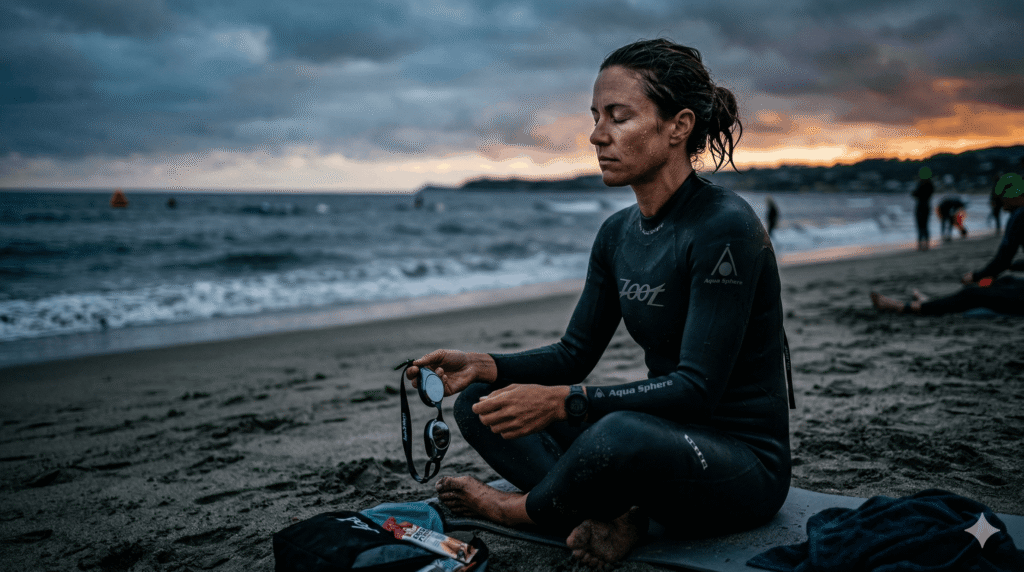
When you feel those nerves on the beach, you must consciously tell yourself, “My body is primed. My engine is revved up. This adrenaline is going to make my stroke more powerful and my pain tolerance much higher.” Conquer pre-race nerves, learn what it takes to race your best when it matters most, and develop a bulletproof mindset for practice and competition.
Part 4: The Ultimate Tool – The Swim Logbook
To systematically track your mental and physical progression, you must document your journey. Relying strictly on your memory is a massive mistake. Elite coaches note that the one tool that has been consistently used by top athletes—from Olympians to national champions—is a structured logbook.
Tracking your practices helps you unleash more motivation, build confidence, and dominate your workouts. However, an elite open-water logbook is not just for recording your 100-meter freestyle splits or how many yards you swam. It is a tool for mental auditing.
After every significant open-water training session, you should log your mental state:
- What was my anxiety level on a scale of 1-10 before entering the cold water?
- Did my equipment perform flawlessly, or did my goggles fog, causing me mental distress?
- Did I successfully execute my process goal of bilateral breathing today?
- When the water got choppy, did I panic, or did I utilize my visualization training to stay calm?
As coach Jake Des Roches explains, resources that help swimmers identify what they can and cannot control are vital for focusing on becoming a greater version of themselves. By physically writing down your mental triumphs and failures, you create a tangible blueprint for your own psychological growth.
Frequently Asked Questions (FAQ)
Q: Can mental training actually make me physically faster in the water? A: Yes, absolutely. While mental training does not magically build muscle mass, it dramatically improves neurological efficiency. When you are mentally calm, your muscles relax, your stroke lengthens, and your hydrodynamic drag decreases. When you panic, your muscles tense up, your hips sink, and you burn twice as much oxygen to go the exact same speed. A calm mind is a fast swimmer.
Q: I have a massive fear of deep, dark water. Can visualization help me overcome this? A: Yes. Fear of deep water (thalassophobia) is incredibly common. You can use visualization as a form of gradual exposure therapy. Start by sitting in a safe, dry room and visualizing yourself comfortably floating in deep water. Pair this with deep, diaphragmatic breathing. Over time, your brain will begin to associate the image of dark water with a state of physical relaxation rather than a state of life-threatening panic.
Q: Should I do my visualization training right before the starting gun fires? A: While a quick mental refresher on the beach is helpful, the bulk of your visualization work should be done in the weeks leading up to the race. Visualization is a skill that requires a relaxed, quiet environment to properly program the central nervous system. Trying to visualize a complex race plan while standing in a crowd of 500 screaming athletes with adrenaline pumping through your veins is nearly impossible.
Q: Does my physical equipment affect my mental state? A: Your gear is intimately tied to your psychology. If you are standing on the beach constantly worrying about whether your goggles will leak or fog up, you are wasting precious cognitive energy that should be focused on your process goals. Investing in heavily tested, high-quality open-water swim goggles eliminates uncontrollable variables, providing the mental peace of mind required to race aggressively.
The Final Verdict: Building the Ultimate Weapon
Your mind is the ultimate governor of your athletic potential. You can possess the cardiovascular capacity of a champion, but if you do not have the mental framework to deploy it under extreme pressure, you will never reach your true limits.
Mental training is not a magical hack; it is a discipline that requires consistent, deliberate practice. You must take the time to define your process goals, rigorously engage in sensory-rich visualization, and actively reframe your pre-race nerves into explosive athletic power.
Equip yourself with the best tools available. Find a perfectly fitting pair of open-water goggles so you never have to worry about vision loss, utilize a dedicated logbook to track your psychological evolution, and trust the process. Build what is in your head, and we will see you dominate the open water.