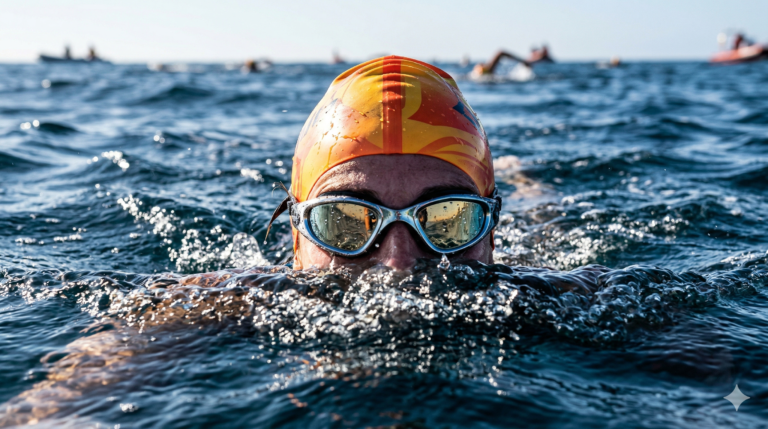
There is a profound difference between swimming gracefully in a heavily chlorinated, temperature-controlled indoor pool and surviving a chaotic, grueling 2.4-mile open-water triathlon swim. In a pool, the environment is entirely predictable. The water is perfectly flat, allowing swimmers to execute long, beautiful, gliding strokes that maximize distance per stroke (DPS).
However, when you transition to the wild, unpredictable environment of the ocean or a choppy lake, that beautiful pool stroke often falls apart completely. The long glide that served you so well in the local aquatic center becomes a massive liability. When you pause and glide in the ocean, the wind, cross-currents, and crashing waves instantly kill your forward momentum. You are essentially forced to re-accelerate your body weight from a dead stop on every single stroke, which rapidly destroys your shoulder muscles and drains your cardiovascular reserves.
To swim fast and efficiently in the open water, you must fundamentally adapt your biomechanics. You need to develop a stroke that provides continuous, relentless propulsion. You must understand everything you need to know about the freestyle pull—how it works, how it differs from regular pool freestyle, and the training methods that actually build pull power and speed.
In this exhaustive 2026 masterclass, the performance experts at OpenWaterGoggles.com will dissect the biomechanical anatomy of the perfect open-water freestyle pull. We will teach you exactly how to master stroke rate for faster freestyle, learn why stroke rate matters, what happens when you push past your natural maximum, and how to build the turnover that holds up on race day. Whether you are a beginner triathlete or a seasoned marathon swimmer, mastering these mechanics will transform you into an unstoppable aquatic engine.
Part 1: The Mechanics of the Open Water Freestyle Pull
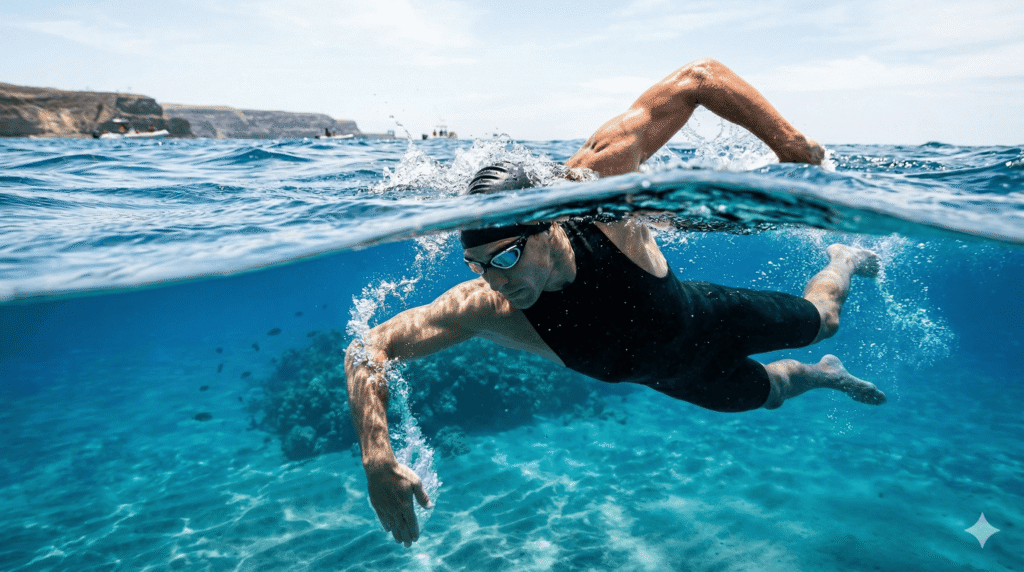
Propulsion in swimming is generated by displacing water. To move forward, you must grab a massive volume of water and violently throw it backward toward your feet. The freestyle pull is not a single, uniform motion; it is a complex biomechanical chain consisting of four distinct phases: The Entry, The Catch, The Power Phase, and The Finish.
Phase 1: The Entry and Extension
Your hand should enter the water fingertips first, roughly in line with your shoulder. A common mistake amateur swimmers make is crossing their hand over the center line of their head (crossover). Crossing over causes your hips to aggressively snake side-to-side, entirely destroying your hydrodynamic streamline and causing you to swim in a zigzag pattern.
Once your hand enters the water, you must extend it forward. However, in open water, you must eliminate the over-glide. In a pool, you might leave your lead arm fully extended for a full second while your other arm recovers. In the ocean, leaving your arm out front for too long means you are relying on momentum that the waves are actively fighting. Your extension should be brief, deliberate, and immediately transition into the catch.
Phase 2: The High-Elbow Catch (Early Vertical Forearm)
The “Catch” is where elite speed is born. If your catch is weak, the rest of your pull is entirely useless.
The absolute golden rule of the freestyle pull is achieving an Early Vertical Forearm (EVF). When you initiate the pull, you do not pull with a straight arm. Pulling with a straight arm pushes water downward toward the bottom of the ocean, lifting your chest up and dropping your hips down, creating massive drag.
Instead, you must keep your elbow high near the surface of the water while you bend your wrist and drop your fingertips toward the ocean floor. By keeping your elbow high and dropping your forearm, you effectively turn your entire hand and forearm into one massive, solid paddle. You are anchoring your arm in the water and pulling your body past it. This EVF position engages the massive muscles of your latissimus dorsi (your back) rather than isolating the tiny, fragile muscles of your rotator cuff.
Phase 3: The Power Phase
Once your forearm is perfectly vertical and you have “caught” a heavy volume of water, you enter the Power Phase. This is where you aggressively accelerate your hand backward under your body.
Your hand should travel in a relatively straight line backward, tracking just outside the center line of your torso. You must pull with maximum violence and speed. The acceleration should constantly build; the fastest part of your underwater pull must be the very end of the motion, not the beginning.
Phase 4: The Finish and Exit
Many swimmers completely waste the final 20% of their stroke by pulling their hand out of the water too early at their waist. To maximize your pull power, you must push the water all the way past your hip. As your hand reaches your upper thigh, aggressively flex your triceps to squeeze every last ounce of propulsion out of the stroke. Your hand should exit the water near your mid-thigh, leading with the elbow to begin the aerial recovery phase.
Part 2: How to Master Stroke Rate for Faster Swimming
Having a mechanically flawless Early Vertical Forearm pull is critical, but it is completely useless if your engine runs too slowly. This brings us to the concept of Stroke Rate (often called turnover or cadence).
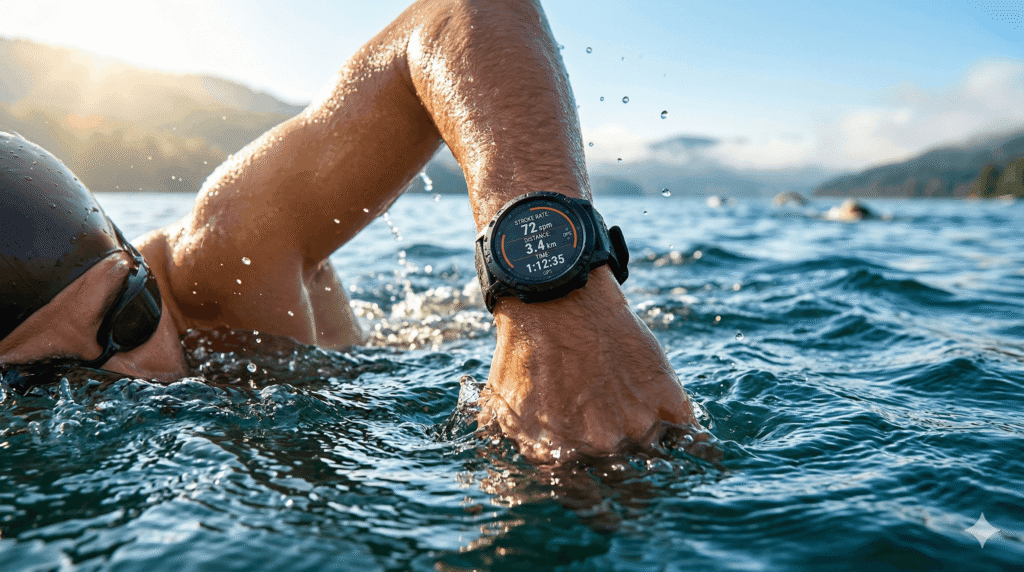
Stroke rate is defined as the number of strokes you take per minute (SPM). In the highly controlled environment of competitive pool swimming, athletes obsess over distance per stroke. However, in the unpredictable open water, stroke rate is your ultimate weapon against the elements.
Why Stroke Rate Matters for Open Water Freestyle
Imagine riding a bicycle up a steep hill in a very high gear. Every single pedal stroke requires a monumental, exhausting effort, and if you stop pedaling for even a second, you roll backward. This is exactly what it feels like to swim in a choppy ocean with a slow stroke rate. The waves act as the steep hill, constantly fighting your forward momentum.
Learn why stroke rate matters for sprint freestyle and open water endurance. By increasing your stroke rate, you essentially shift your bicycle into a lighter gear. You take slightly shorter, much faster strokes. This continuous, rapid turnover ensures that your arms are always generating forward propulsion, slicing through the oncoming waves before they have a chance to stall your momentum. A higher stroke rate keeps your body riding high on top of the water rather than sinking deep into the troughs between the swells.
Finding Your Optimal Cadence
So, what is the perfect stroke rate? It is highly individual. Elite Olympic 10K marathon swimmers typically hold a blistering stroke rate of anywhere from 75 to 90 strokes per minute. For the average age-group triathlete, a sustainable open-water stroke rate usually falls between 60 and 75 strokes per minute.
However, you must be careful. Learn what happens when you push past your natural maximum. If you artificially force your stroke rate to 85 SPM without the necessary cardiovascular conditioning, your technique will instantly disintegrate. You will start “spinning” your arms—moving them incredibly fast but slipping through the water without actually catching any volume. You will completely exhaust your heart rate within 400 meters and risk severe hyperventilation.
Training Methods to Build Pull Power and Speed
How do you build the turnover that holds up on race day without sacrificing your technique? You must incorporate specific stroke rate training into your weekly regimen.
1. Use a Finis Tempo Trainer Pro: This small, waterproof metronome fits under your swim cap and beeps at a precise interval. If your current natural stroke rate is 60 SPM (one stroke every 1.0 seconds), set the metronome to beep every 0.95 seconds. Your goal is to force your hand to enter the water exactly on the beep. Over several weeks of training, gradually decrease the interval by 0.05 seconds until you comfortably adapt to a faster cadence of 65 or 70 SPM.
2. Over-Speed Tether Training: To teach your central nervous system how to move your arms faster, attach a stretch cord to the starting block and loop it around your waist. Swim aggressively away from the wall to stretch the cord. When the cord is fully tensioned, turn around and sprint back to the wall. The massive assistance from the retracting rubber cord will pull you through the water faster than you can naturally swim, forcing your arms to drastically increase their stroke rate to keep up with the velocity.
3. Integration with Top Swim Apps 2026: You cannot improve what you do not measure. Using the top 5 swim apps of the year to track progress and boost performance is mandatory for serious athletes. Paired with a high-end GPS smartwatch or augmented reality goggles, these apps analyze your exact stroke rate metrics during your open water swims, allowing you to see exactly when your cadence drops due to fatigue.
Part 3: The Breathing Mechanics Dilemma
When discussing ultimate speed, we must address oxygen intake. Why elite sprinters don’t breathe in the 50 freestyle is a fascinating biomechanical reality. Turning your head to breathe disrupts your spinal alignment, drops your opposite arm prematurely, and creates a massive pocket of hydrodynamic drag. For a 21-second race in the pool, elite sprinters simply hold their breath to eliminate this drag.
However, you are training for open-water survival. You cannot hold your breath for a 2.4-mile Ironman swim. You absolutely must breathe, and you must do it efficiently without ruining the freestyle pull mechanics we just built.
The Golden Rule of Open Water Breathing: You must master bilateral breathing (breathing on both the left and right sides). In a pool, you can get away with breathing exclusively to your dominant side. In the ocean, unilateral breathing is a fatal flaw.
If you only breathe to your right, your left arm will naturally drop, and you will continuously veer off course to the left. Furthermore, if the sun is rising on your right side, or if a massive ocean swell is constantly crashing into your right shoulder, you will swallow gallons of saltwater if you cannot seamlessly switch to breathing on your left side.
To breathe without destroying your pull power, you must separate the act of sighting from the act of breathing. Use the “Alligator Eyes” technique to lift your eyes slightly forward to locate the navigation buoy, drop your head back into the water, and then smoothly rotate your head to the side to take your breath while keeping one eye completely submerged. This ensures your hips remain high and your EVF catch remains powerful.
Part 4: Dryland Training for Freestyle Power
As we have covered extensively in our training archives, swimming fast requires extreme muscular endurance. Dryland training builds the strength, power, and stability sprint freestylers need to explode off the block, nail the turn, and hold speed to the wall. For open water swimmers, this exact same dryland philosophy must be applied to build the latissimus dorsi endurance required to sustain a high stroke rate for hours.
You must program heavy resistance band pulls into your weekly routine. Loop thick surgical tubing around a post, bend over at the waist, and intensely practice the Early Vertical Forearm motion. By building immense pull power and speed on land, your arms will feel significantly lighter and more explosive when you enter the water, allowing you to easily maintain a rapid 70 SPM stroke rate against the ocean currents.
Frequently Asked Questions (FAQ)
Q: If I increase my stroke rate, won’t my heart rate spike uncontrollably? A: Initially, yes. Increasing your stroke rate requires your cardiovascular system to deliver more oxygen to your rapidly moving muscles. This is why you must increase your stroke rate incrementally using a tempo trainer (e.g., adding only 2 to 3 strokes per minute per week). Over time, your aerobic capacity will adapt, and the faster cadence will feel completely natural and highly efficient.
Q: How do I know if my stroke rate is too slow for the open water? A: A strong indicator of a slow stroke rate is a feeling of “stalling” between strokes. If you feel your hips sinking heavily toward the ocean floor during your glide phase, or if you feel like you are constantly fighting to regain momentum after every breath, your stroke rate is too low. You are relying on a pool-style glide that does not work against ocean currents.
Q: Should my hand enter the water thumb-first to slice through the water faster? A: Absolutely not. Entering thumb-first internally rotates the shoulder joint to an extreme degree. Doing this repetitively for thousands of strokes will almost guarantee that you develop severe shoulder impingement (Swimmer’s Shoulder). Your hand should enter the water relatively flat, with your middle fingers piercing the surface first, keeping the shoulder joint in a safe, neutral position.
Q: Can wearing the wrong goggles affect my stroke rate and pull mechanics? A: Yes, significantly. If you wear cheap, leaky goggles that constantly fog up, your brain will trigger a panic response. This pre-race nerve reaction causes you to hyperventilate and lose your rhythm. Furthermore, if your goggles have a narrow field of vision, you will be forced to lift your head violently out of the water to sight the buoys. This destroys your high-elbow catch and drops your hips. This is why investing in the best anti-fog swim goggles of 2026 for clear vision every lap is an absolute necessity for holding your stroke rate.
The Final Verdict: Forging an Unstoppable Engine
Swimming fast in the open water is not an art; it is a brutal, calculated application of physics, biomechanics, and relentless conditioning.
You must abandon the lazy, slow-gliding habits developed in the indoor pool. To conquer the ocean, you must completely master the mechanics of the high-elbow Early Vertical Forearm catch. You must build the muscular endurance to violently accelerate water backward past your hips, and most importantly, you must systematically train your central nervous system to hold a rapid, relentless stroke rate that punches through the chaotic waves.
Equip yourself with premium, wide-view goggles so you never have to break your rhythm to sight a buoy. Utilize top swim apps and smartwatches to track your cadence, heavily invest in your dryland pulling power, and we will see you tearing through the open water with explosive, effortless speed.