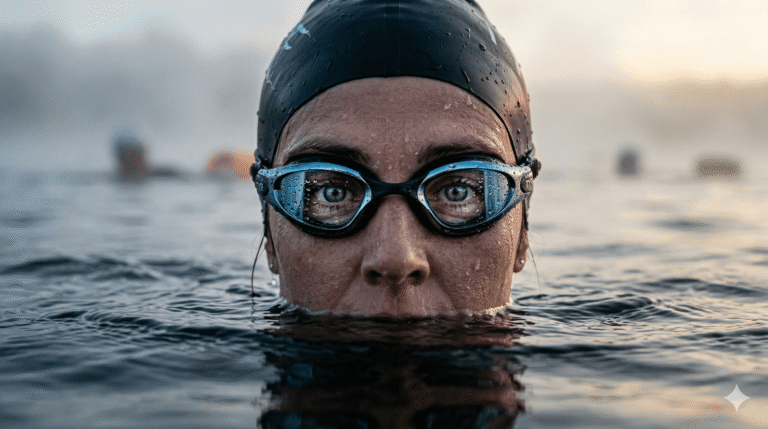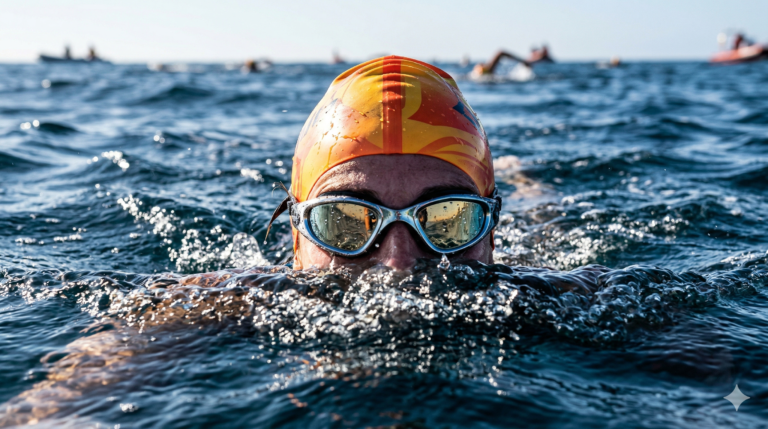
The Ironman triathlon is widely considered the ultimate test of human endurance. Before you even touch your extremely expensive aerodynamic bike or lace up your carbon-plated marathon shoes, you must survive the water. The 2.4-mile (3.86 km) open-water swim is an intensely chaotic, physically demanding, and psychologically grueling battle. You are not just fighting the sheer distance; you are battling freezing water temperatures, blinding sun glare, unpredictable ocean swells, and the infamous “washing machine” of a mass start where hundreds of thrashing limbs are fighting for the exact same racing line.
In this brutal environment, your equipment can either be your greatest asset or your absolute downfall. If your goggles leak at mile one, you have another 1.4 miles of burning saltwater in your eyes. If your lenses fog up permanently, you will zig-zag across the course, adding massive, exhausting distance to your race. Finding the best swim goggles for an Ironman race is a non-negotiable requirement for success. You need a pair that offers bulletproof impact resistance against accidental kicks to the face, crystal-clear peripheral vision for sighting buoys, and absolute, leak-proof comfort that lasts for well over an hour of continuous swimming.
In this ultimate 2026 guide, the gear analysts at OpenWaterGoggles.com dive deep into the specific demands of long-distance triathlon swimming. We rank the absolute best Ironman-ready goggles on the market, break down the science of lens selection, and provide you with elite mental strategies to conquer your pre-race nerves on the biggest day of your athletic life.

Quick Comparison: Top Ironman Swim Goggles of 2026
To help you make a rapid, data-driven decision for your upcoming race, here is our meticulously tested lineup of the best goggles designed to survive a 2.4-mile open-water swim.
| Product Name | Best For | Key Feature | Check Price |
|---|---|---|---|
| FORM Smart Swim 2 | Perfect Pacing & Data | Real-time AR display & Heart Rate | |
| Magic5 Custom Goggle | 2.4-Mile Comfort | 3D-scanned leak-proof fit | |
| Arena Cobra Ultra Swipe | Low-Profile Racing | Swipe anti-fog technology | |
| ZIONOR Upgraded G1 | Blinding Ocean Sun | Polarized lenses & wide view | |
| Aegend Swim Goggles | Transition Bag Backup | Easy-plug buckle & durable frame | |
(Note: Click the links above to check current prices and availability on Amazon).
The Ironman Testing Protocol: How We Evaluate Gear
At OpenWaterGoggles.com, we understand that what works for a 20-minute indoor pool workout will critically fail during an Ironman. Our lead analyst, Marcus Vane, along with a squad of seasoned Ironman finishers, tested these goggles under extreme conditions that mimic race day reality.
Here is our rigorous evaluation criteria specifically tailored for long-distance triathlons:
1. The 90-Minute Endurance Test: While our standard test is 60 minutes, Ironman swims take the average athlete between 1 hour and 15 minutes to 2 hours to complete. We wear each pair for a continuous 90-minute open-water session. We ruthlessly evaluate the suction quality and silicone softness. If a goggle creates migraine-inducing pressure or leaves deep, bruised marks around the orbital bone after 90 minutes, it is instantly disqualified.
2. The Mass Start Impact Test: The first 400 meters of an Ironman is a literal fight for space. Accidental kicks and elbows to the face are incredibly common. We evaluate the structural integrity of the frame and the cushioning of the silicone gasket to ensure that an accidental strike will not drive hard plastic deep into your eye socket.
3. Sighting and Navigation Clarity: A 2.4-mile course usually involves swimming far away from the shoreline, making navigation buoys look like tiny specks on the horizon. We test the peripheral width of the lenses and the effectiveness of polarized and mirrored coatings against direct, blinding sun glare bouncing off ocean swells.
The 5 Best Swim Goggles for Ironman Races
After hundreds of miles logged in oceans, deep-water quarries, and massive lakes, these five goggles have proven to be the ultimate tools for long-distance triathlon domination.
1. Best Overall for Ironman Pacing: FORM Smart Swim 2
In a 2.4-mile swim, going out too fast in the first 1000 meters will completely destroy your energy reserves for the 112-mile bike ride that follows. The FORM Smart Swim 2 is an absolute revolution for Ironman athletes who need to strictly control their pacing.
Why it dominates the Ironman: This is not just a goggle; it is a wearable computer. The FORM Smart Swim 2 features an integrated augmented reality (AR) display built directly into the lens. As you swim, it projects your live metrics—including your exact split times, stroke rate, and distance—right into your line of sight without ever forcing you to break your stroke to look at a wrist watch.
The Tech & Fit: The updated version 2 features a built-in heart rate sensor located right on the temple, allowing you to stay perfectly within your Zone 2 aerobic threshold. The premium silicone eye seals are robust and surprisingly comfortable for a high-tech device, ensuring a secure fit during the chaos of a mass start.
The Verdict: If you are a data-driven triathlete whose biggest weakness is burning out too early in the swim, the FORM Smart Swim 2 will act as your digital coach, keeping your pace locked in for the entire 2.4 miles.
2. Best for Extreme 2.4-Mile Comfort: Magic5 Custom Goggle
Pain is a major distraction. When you are an hour into your swim, the last thing you want to focus on is the excruciating pressure on the bridge of your nose. The Magic5 Custom Goggle completely eliminates this issue.
Why it dominates the Ironman: Standard goggles rely on strap tension to force a piece of generic plastic to bend to your face. The Magic5 takes a radically different approach. You use a smartphone app to perform a highly detailed 3D scan of your specific facial bone structure. The company then 3D-prints the goggles to match the exact topography of your eye sockets.
The Tech & Fit: Because the fit is mathematically perfect, you do not need to crank the straps tight. The goggles naturally rest on your face, creating an airtight, leak-proof vacuum seal. This means you can swim for two straight hours without a single drop of saltwater entering your eyes, and you will finish the swim without any painful suction rings on your face.
The Verdict: For long-distance comfort and guaranteed leak prevention during an Ironman, the Magic5 is widely considered the pinnacle of modern swimming gear.
3. Best Anti-Fog for Long Distances: Arena Cobra Ultra Mirror Swipe
Fog is the silent killer of an Ironman swim. It forces you to stop, tread water, and constantly wipe your lenses, breaking your rhythm and slowing you down. The Arena Cobra Ultra Mirror Swipe solves this permanently.
Why it dominates the Ironman: While originally favored by Olympic pool sprinters, long-distance open water swimmers have adopted this goggle for its aggressive, low-profile hydrodynamics and its unmatched anti-fog longevity.
The Tech & Fit: The magic lies in the revolutionary Swipe technology. Traditional factory anti-fog coatings degrade quickly in harsh saltwater. With the Arena Cobra, if the lenses begin to cloud over at mile 1.5, you do not need to spit in them or use chemical sprays. You simply swipe the inside of the wet lens firmly with your fingertip. This physical friction reactivates the chemical anti-fog layer, instantly restoring crystal-clear vision.
The Verdict: If your primary anxiety is losing your visibility halfway through the race, the Swipe technology makes this goggle an incredibly reliable, high-performance weapon.
4. Best for Blinding Ocean Starts: ZIONOR Upgraded G1 Polarized
Many Ironman races feature an early morning start where you are forced to swim directly east, staring straight into the rising sun. In these conditions, standard mirrored lenses are simply not enough.
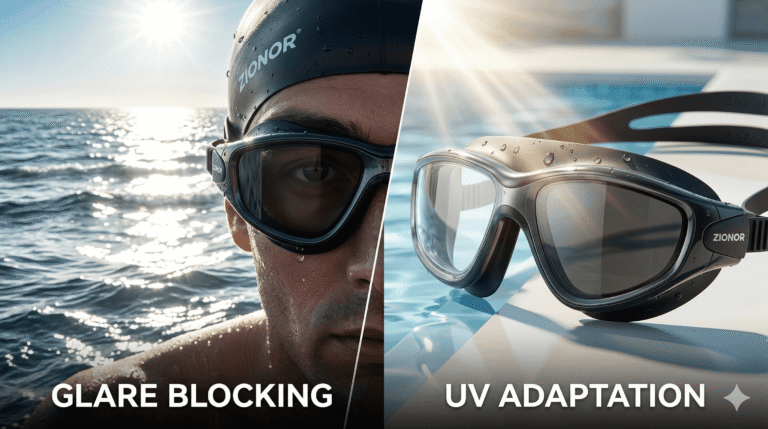
Why it dominates the Ironman: The ZIONOR Upgraded G1 is an oversized, wide-view goggle that excels in chaotic ocean conditions. It features high-grade polarized lenses that utilize a chemical filter to aggressively neutralize the horizontal light waves bouncing off the ocean swells. This actively eliminates blinding sun glare.
The Tech & Fit: The wider mask-like silicone gasket sits further away from the eye socket, distributing pressure across the cheekbones and forehead. This larger surface area provides excellent shock absorption if you take an accidental heel to the face during the start.
The Verdict: For sunny, high-glare ocean courses like Ironman Hawaii or Ironman Florida, the ZIONOR G1 provides the ultimate combination of eye protection and expansive peripheral vision.
5. The Mandatory Transition Bag Backup: Aegend Swim Goggles
A seasoned Ironman athlete knows that having a “Plan B” is the golden rule of racing. Goggle straps can snap in the transition area, or you might accidentally drop them on the beach before the starting gun.
Why it dominates the Ironman: You must always have a reliable backup pair in your gear bag. The Aegend swim goggles offer unbeatable, rugged value. Featuring high-quality, ultra-flexible silicone seals and an incredibly convenient easy-plug buckle system, they can be thrown on in a panic and instantly adjusted to fit almost any face shape.
The Tech & Fit: They are highly durable, highly flexible, and incredibly affordable. While you might not plan to use them as your primary race gear, their reliability under pressure makes them an absolute lifesaver when disaster strikes.
The Verdict: Never travel to an Ironman without a backup. The Aegend is the perfect, budget-friendly insurance policy for your race day.
Buying Guide: Preparing Your Gear for 2.4 Miles
Buying the right goggles is only the first step. Surviving an Ironman swim requires strategic gear preparation. Here are the expert protocols you must follow:
1. The “Two Pair” Rule for Tints: Weather on race morning is unpredictable. An overcast sky requires a completely different lens than a bright, sunny morning. Elite athletes always pack two pairs of their chosen goggles: one with a dark polarized or mirrored lens for bright sun, and one with a clear, yellow, or photochromic lens to maximize contrast in dark, cloudy conditions. You make the final decision 20 minutes before the starting gun.
2. Securing the Strap: In a mass start, getting your goggles kicked off your head is a very real threat. To prevent this, always put your goggles on first, and then pull your race-issued silicone swim cap over the top of the goggle straps. This locks the straps securely against your head, ensuring they stay in place even during heavy physical contact.
3. Pre-Race Anti-Fog Protocol: Even if you buy premium goggles, you must protect the coating. Never touch the inside of the lens with your dry fingers or a towel. The night before your Ironman, wash the lenses with fresh water and apply a high-quality, reef-safe anti-fog spray. Let it dry overnight, and rinse it lightly just before you enter the water.
The Mental Edge: Conquering the Ironman Swim
In an event that lasts anywhere from 9 to 17 hours, mental fatigue will set in long before physical exhaustion. The 2.4-mile swim is often the most anxiety-inducing portion of the day.
Struggling with intense pre-race nerves on the beach is entirely normal, even for professionals. The sheer volume of athletes, the loud music, and the vast expanse of the ocean can trigger a panic response. However, elite performance psychology teaches us that you must focus exclusively on what you can control. You cannot control the water temperature, the choppy waves, or the aggressive swimmers around you. But you can absolutely control your breathing rate, your pacing strategy, and your trust in your equipment.
When you are fully confident that your custom-fitted Magic5 goggles will not leak, or that your FORM Smart Swim 2 will keep you strictly in Zone 2 heart rate, you eliminate massive psychological variables. This gear confidence allows you to successfully utilize visualization techniques. In the weeks leading up to your Ironman, close your eyes and visualize the chaos of the mass start. See yourself remaining perfectly calm, sighting the first buoy clearly through your polarized lenses, and executing a flawless, rhythmic stroke. Mental training is one of the most powerful tools in a swimmer’s arsenal, ensuring that when the cannon fires, you are mentally bulletproof.
Frequently Asked Questions (FAQ)
Should I wear a swimming mask or standard goggles for an Ironman?
This is a matter of personal preference. Swimming masks (which are larger and cover more of the face) offer superior peripheral vision and disperse pressure widely across the face, which is great for long distances. However, they are bulkier and have more drag. Standard low-profile goggles (like the Arena Cobra) are faster but can be less comfortable over 90 minutes. We recommend a hybrid like the Magic5, which offers the slim profile of a standard goggle with the supreme comfort of a mask.
How do I handle an anxiety attack or panic during the mass start?
Panic attacks are common when cold water hits your face and hundreds of swimmers surround you. If you feel panic setting in, swim to the outside edge of the pack to find clear water. Flip onto your back, let your wetsuit float you, and take deep, slow breaths to lower your heart rate. Once your breathing normalizes, adjust your goggles, pick a sight line, and slowly resume your freestyle stroke.
Are polarized lenses better than mirrored lenses for an Ironman?
If you are racing in an ocean or a large lake on a sunny day, polarized lenses are significantly superior. Mirrored lenses only reflect light away, making the environment darker. Polarized lenses contain a specific chemical filter that actively blocks horizontal light waves, completely neutralizing the blinding glare that bounces off the water’s surface. This makes sighting buoys dramatically easier and reduces eye fatigue.
Are polarized lenses better than mirrored lenses for an Ironman?
If you are racing in an ocean or a large lake on a sunny day, polarized lenses are significantly superior. Mirrored lenses only reflect light away, making the environment darker. Polarized lenses contain a specific chemical filter that actively blocks horizontal light waves, completely neutralizing the blinding glare that bounces off the water’s surface. This makes sighting buoys dramatically easier and reduces eye fatigue.
Do I need a smart goggle like the FORM Smart Swim 2 to succeed?
You do not need it to finish, but it is an incredible strategic advantage. Ironman pacing is notoriously difficult because you cannot easily check a wristwatch while swimming freestyle. The AR display in the FORM goggles prevents you from swimming too fast in the first half of the race, ensuring your legs are fresh for the grueling 112-mile bike ride.
The Final Verdict
The Ironman swim is a chaotic, beautiful, and utterly exhausting beast. It requires months of physical conditioning, elite mental training, and the absolute best gear on the market.
If you are a highly analytical triathlete who struggles with race-day pacing, the FORM Smart Swim 2 is a revolutionary investment that will change how you race. If you want to completely eliminate the physical pain of long-distance swimming, the 3D-scanned Magic5 Custom Goggle offers an unparalleled, leak-proof experience. And for those racing in harsh, blinding ocean conditions, the ZIONOR Upgraded G1 Polarized will be your ultimate shield against the elements.
Prepare your gear, trust your training, conquer your pre-race nerves, and we will see you cross the finish line. You are an Ironman.